Two wheelsMarbella
Bike hire on the Paseo Marítimo in Marbella
Mar–Nov
The seafront looks like one continuous cycle route and it is not. Where the Paseo Marítimo lets you ride, where it makes you walk, where the river mouths interrupt it, and what kind of bike is worth hiring for a coast that is flat, hot and busier than it looks.
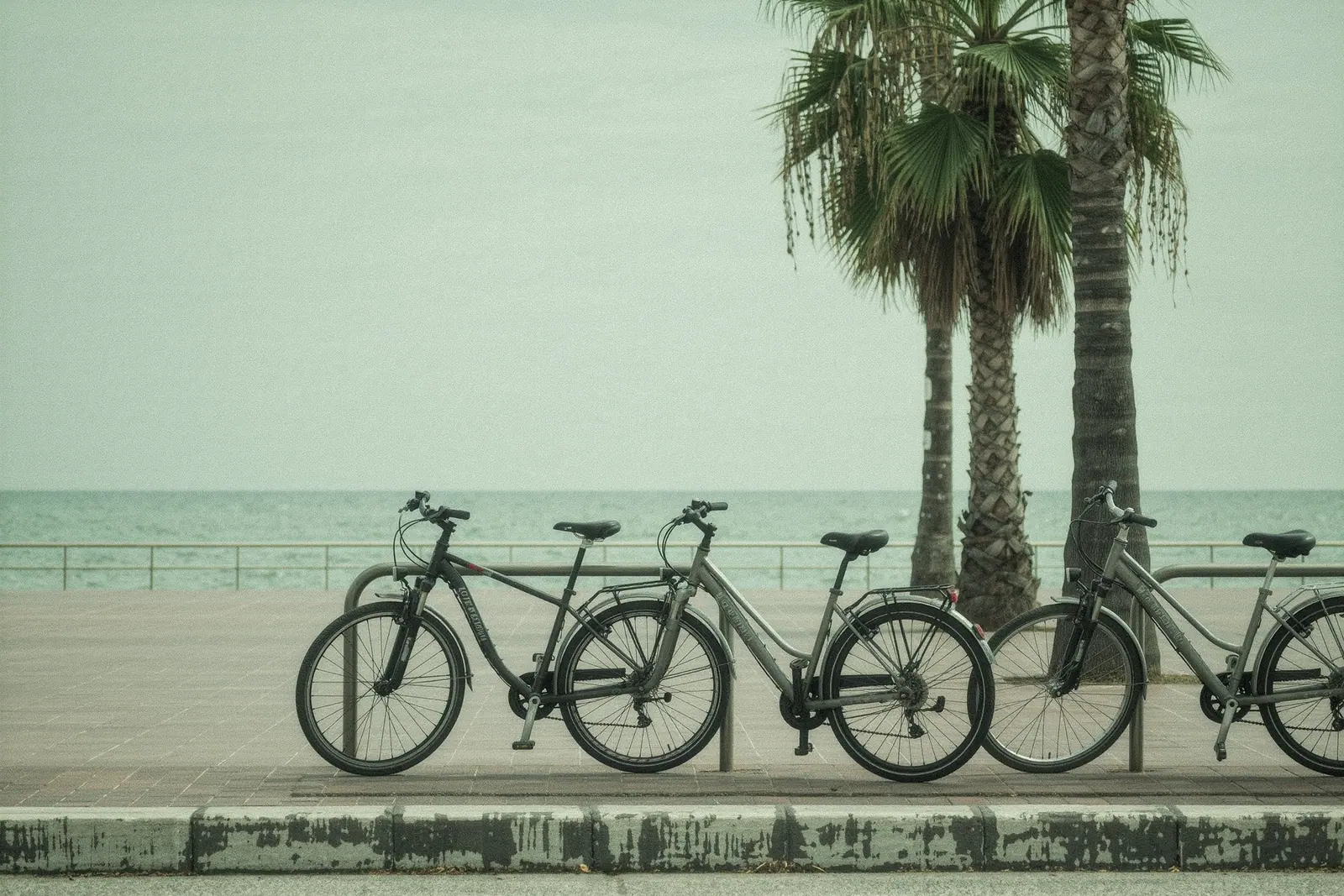
The seafront at Marbella reads, on a map, as a single line from the fishing harbour west to Puerto Banús and beyond. In reality it is a sequence of promenades, boardwalks, beach-front lanes and short inland detours that changes character every kilometre and occasionally stops being cyclable altogether.
That is worth knowing before you hire, because it decides both the bike and the plan. This is not a route you attack. It is a route you drift along, and the right machine for it is unfashionable.
What the seafront actually consists of
Working from the town westwards:
- Around the Puerto Deportivo and Playa de la Bajadilla. Working harbour, then the eastern end of the town promenade. Busy, mixed use, slow.
- The central Paseo Marítimo. The heart of it, running past La Fontanilla and the town beaches. In July and August this is dense with pedestrians all evening. Ride at walking pace or walk.
- The Golden Mile stretch, past Nagüeles. Wider, greener, quieter, and the best cycling on the whole seafront. Palms, low walls, the beach on one side.
- Río Verde. The first real interruption. River mouths on this coast break the promenade, and getting across usually means a short move inland to a bridge.
- Puerto Banús. Around the marina the route becomes streets, car parks and crowds. Slow, and the place where a bike is most likely to be stolen.
- West of Banús towards San Pedro. Boardwalk and promenade sections in improving condition, then San Pedro’s own seafront and its boulevard inland.
The Senda Litoral, the long-running project to link the coastal path along the whole province, has closed a lot of these gaps and continues to close more. What exists on the ground at any given time is ahead of most maps and behind most descriptions, so ask the shop what is currently open.
What to hire, and what not to
| Bike | Suits | Avoid because |
|---|---|---|
| City bike with basket | Almost everyone here | Nothing; this is the right answer |
| Hybrid | Longer runs to San Pedro and back | Slightly less comfortable in traffic |
| E-bike | Anyone going inland or uphill | Overkill for the flat seafront alone |
| Road bike | Getting out of town early and going up | Useless on a crowded promenade |
| Beach cruiser | Short pottering, photographs | Single speed and heavy in a headwind |
| Folding bike | Combining with a car boot | Small wheels are poor on boardwalk joints |
The basket, or a rear rack, is the underrated part. A morning on this seafront usually involves a towel, a coffee, something bought at a market and a pair of shoes, and a bike with nowhere to put any of it gets abandoned by day two. Ask specifically; plenty of hire fleets here are basketless.
The practical business of renting one
Rates are quoted by the hour, the day and the week, and the week is dramatically better value than three separate days. Most shops will deliver to a hotel or a villa, which is worth taking if you are staying up the hill, because riding a city bike back up to Sierra Blanca is not a thing anyone does twice.
On the deposit, the norm is a card hold, and that is the mechanism to insist on. Some smaller operations still ask to keep a passport or an identity card while you have the bike. Decline it. There is no reason to leave a travel document with anyone, and the card authorisation exists precisely so you do not have to.
Ask what the lock is. Around the marina and the town centre a cable lock is decoration. A decent D-lock through the frame and a fixed object is the minimum, and if the bike is being left anywhere for more than a few minutes in Puerto Banús, it wants to be somewhere overlooked.
Heat, wind and the times of day that work
The coast is flat, which means the two variables are temperature and wind.
From late June to early September, the middle of the day is genuinely unpleasant on an unshaded promenade, and the sensible ride is before ten in the morning or after seven in the evening. The evening one is more crowded; the morning one is the good one, with the light along the water and the seafront almost empty.
Wind matters more than the flat profile suggests. A levante blowing from the east will push you west effortlessly and then hold you at walking pace for the whole return. Ride into the wind first. It is an obvious rule and almost nobody applies it on a holiday.
Where this route stops being enough
Two directions, both of which need a different bike.
Going west, the full run out to San Pedro de Alcántara and back is a proper outing, flat but long enough to matter with children in tow — that specific trip is covered in family bike hire between Marbella and San Pedro.
Going north, the ground rises almost immediately behind the coast road, and the urbanisations climbing into Sierra Blanca are steeper than they look from below. On a city bike that is a walk. On an assisted bike it is a pleasant hour, which is the whole argument in e-bike hire and the climb into Sierra Blanca.
For anyone whose real interest is riding rather than pottering, the seafront is a warm-up and the actual roads start inland, early in the morning, heading for the climb towards Ronda. Hire accordingly, and do not let a shop talk you into a road bike for a promenade or a cruiser for a mountain.
What to check before you book
- Ask which sections of the promenade the shop considers rideable and which require walking. Local rules differ along the route and are signed in places.
- Check the lock that comes with the bike. A cable lock is not adequate anywhere near the marina.
- Refuse a passport as a deposit. A card hold is the normal mechanism and there is no reason to hand over a document.
- Test the saddle height and the brakes before leaving the shop, not at the first junction.
- Ask whether a basket or a rack can be fitted. Carrying beach kit on a bike without one is the main reason people give up on the second day.
- Confirm what happens with a puncture on the promenade — whether there is a pickup and what the number is.
Questions people actually ask
- Can you cycle the whole Marbella seafront?
Not as one uninterrupted ride. The Paseo Marítimo and the coastal boardwalks cover a long stretch of the shoreline, but the surface, width and status change repeatedly, some sections are pedestrian and signed as such, and river mouths force short detours inland. Treat it as a linked series of good sections rather than a single continuous cycleway.
- Are bikes allowed on the promenade?
It depends on the section, and it is governed by municipal rules that are signed locally and revised from time to time. Some stretches have a marked cycle lane, some tolerate careful riding, and some are pedestrian only, particularly the busiest parts in the town centre in summer. Look at the signs, ride slowly and be prepared to walk; the fine is not the point, the pushchairs are.
- What kind of bike should I hire here?
A plain city or hybrid bike with a basket, upright bars and reliable brakes. The coast is flat, the distances are modest and nothing about the promenade rewards a fast bike. If you plan to leave the seafront and go inland at all, an assisted bike changes the calculation entirely because the ground rises quickly behind the coast road.
- Is bike theft a problem in Marbella?
Enough of one that the lock matters. Around Puerto Banús, the town centre and the busier beach access points, an unattended bike with a cable lock is at real risk. Ask for a decent D-lock, lock the frame to something fixed rather than the wheel, and do not leave a hire bike overnight anywhere except inside the property.